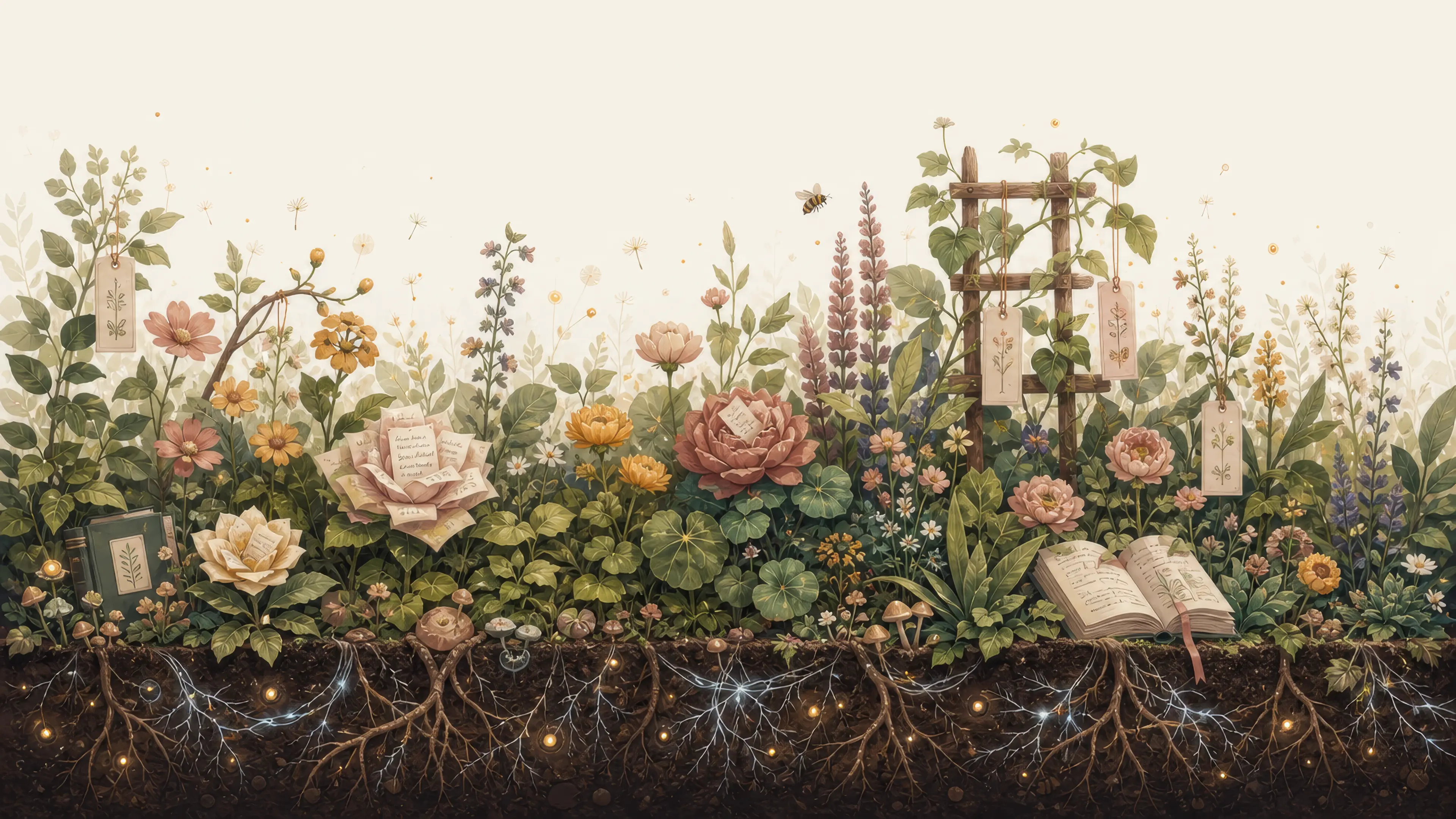
Somewhere in your bookmarks, your notes app, your read-later queue, your half-filled notebooks, somewhere in all of that, there is a garden. You just can’t see it yet.
 Generated with AI
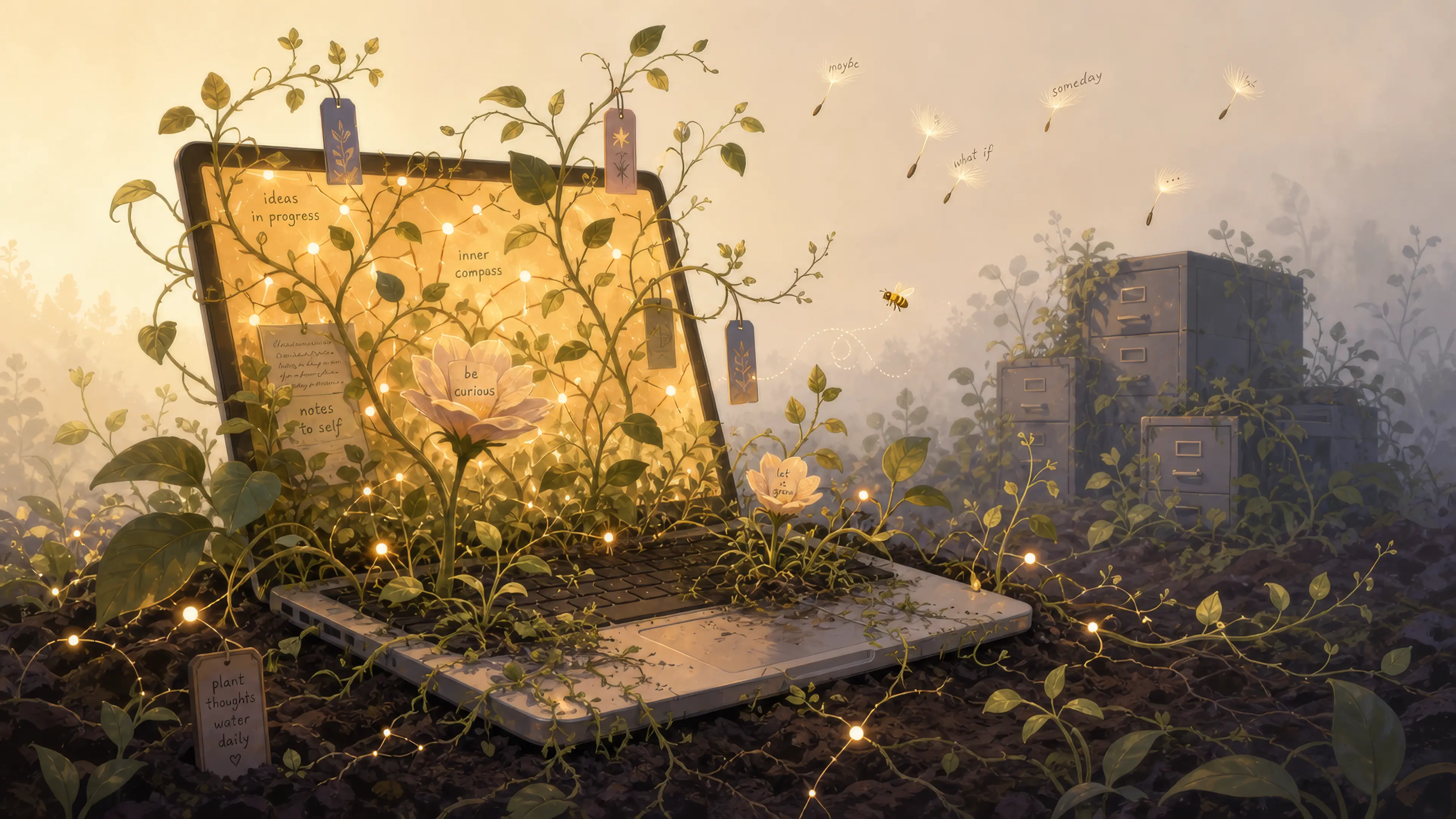
What you see instead is the overgrowth. The hundred open tabs. The folder called “Read Later” that you have never, not once, read later. The note you wrote at 2 AM that felt like a breakthrough and now sits three levels deep in a hierarchy you designed for a different you on a different Thursday. The bookmarks you saved with genuine intention, now rotting quietly in a graveyard of good ideas.
We Never Got the Thing We Were Promised.
Computers were meant to become bicycles for the mind, extensions of thought, amplifiers of curiosity 1 The idea that computers are like a bicycle for our minds from a famous Steve Jobs speech can be traced back to Douglas Engelbart, who said in a 1962 paper that computers should be tools to augment human thinking, not replace it. The metaphor has been widely adopted in the tech industry to describe how computers can amplify human creativity and problem-solving.. Instead we got new ways to bury ideas. A feed that makes everything feel urgent but nothing feel lasting. A folder that makes everything findable but nothing feel connected. A system that makes it easy to collect and impossible to cultivate.
We organize by date because the tools make it easy, not because dates are how thinking works. We sort by topic because folders demand it, not because topics are how ideas actually connect. Sometimes the presence of specific folders prevents us from making surprising connections between otherwise related topics. The structure meant to help becomes the wall we can’t see past 2 Mike Caufield’s “The Garden and the Stream” introduced the central metaphor: the stream (chronological feeds) has become the web’s default, but thinking doesn’t work like a feed, it works like a garden. Nayuki’s Designing better file organization around tags, not hierarchies demonstrates how hierarchical folders force single-parent relationships onto ideas that are naturally multi-contextual..
And when you try to get more intentional, to build a system, a Zettelkasten, a second brain, something strange happens. Somewhere between the intention to think more clearly and the work of actually doing it, the apparatus of knowledge management eats the knowledge 3 Sindhu describes this in Digital gardening in the age of AI as “a failure mode in knowledge management that is as old as knowledge management itself”. The work of maintaining the system becomes more important than the work of thinking itself.. You become the librarian of ideas you never actually think about. The system demands maintenance. The folders need naming. The tags need conventions you’ll abandon by March. The links need to be drawn by hand, one by one, in moments of energy you don’t have and won’t have.
 Generated with AI
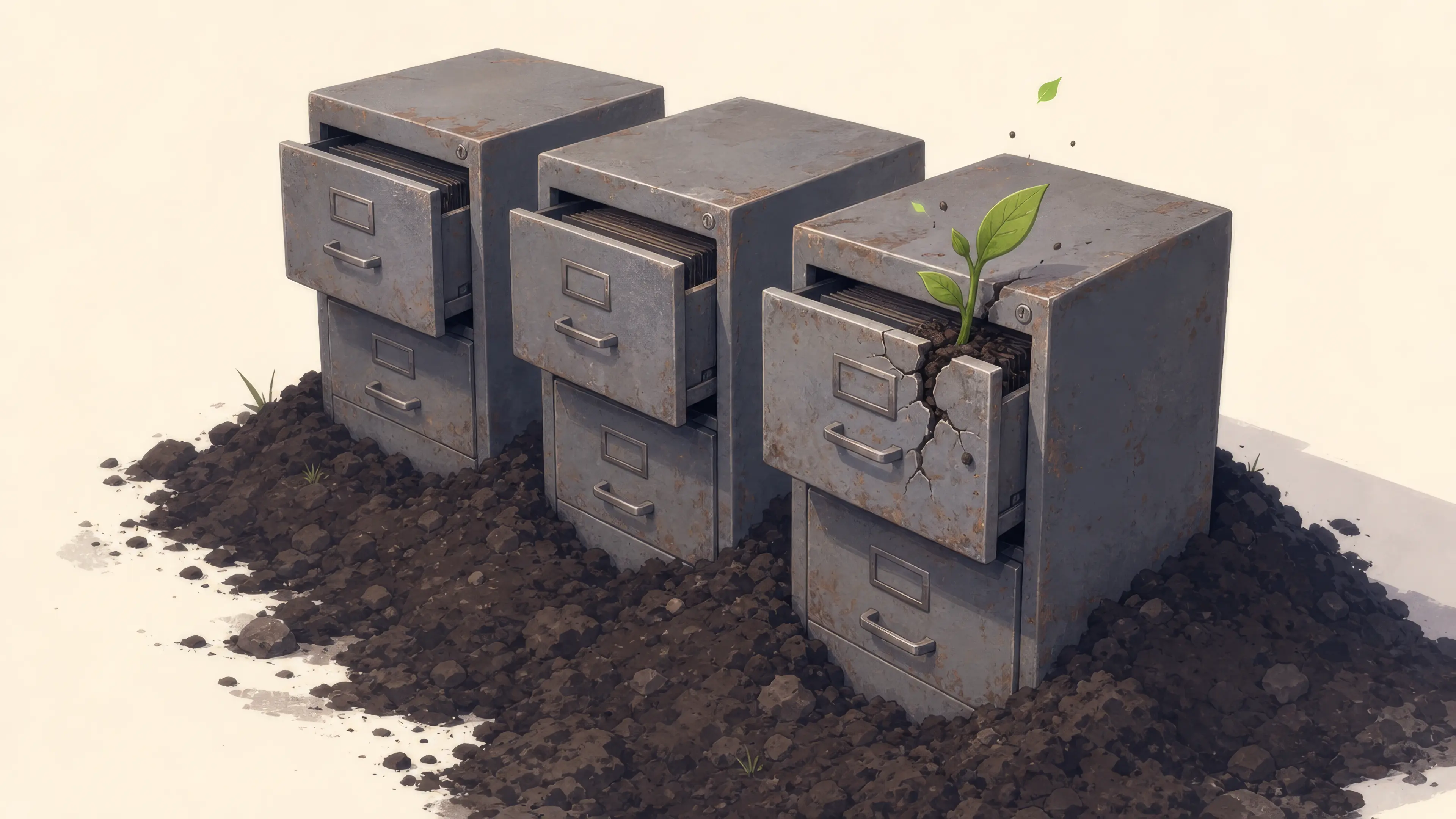
What starts as a garden becomes a filing cabinet. And then the filing cabinet becomes a graveyard.
The Alternative Is Not a Better Filing Cabinet.
It’s a garden.
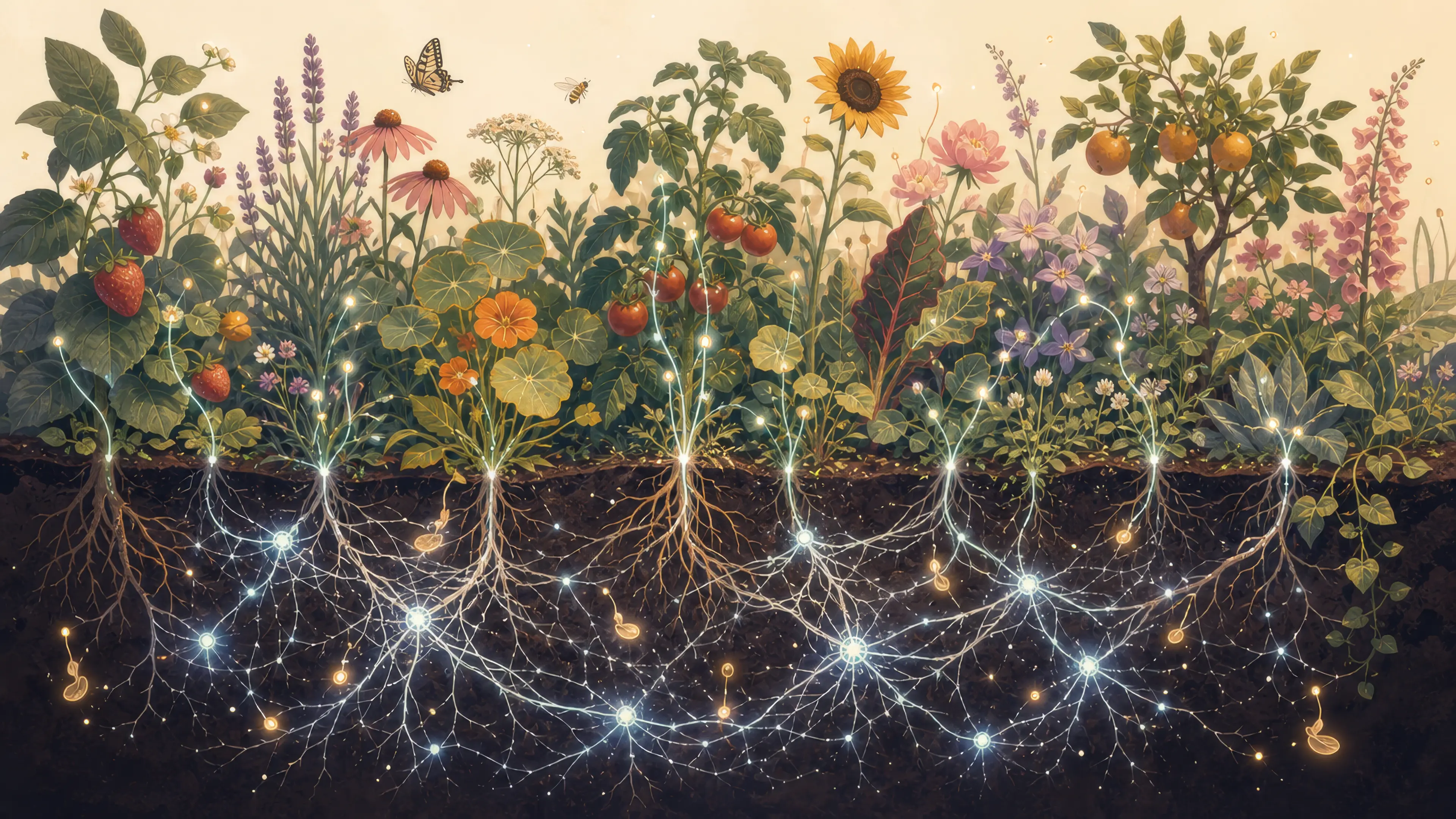
A garden is not neat. A garden does not sort by date. A garden is a mess of entangled growth; things planted in different seasons, for different reasons, growing into each other in ways you didn’t plan and couldn’t predict. A perennial you forgot about comes back on its own. Something you planted three years ago suddenly blooms next to something you planted yesterday, and you realize they belong together, and you would never have put them in the same folder. The garden doesn’t organize itself, but it doesn’t need you to organize it either. It grows. You tend.
 Generated with AI
This is a digital garden: a knowledge space that rejects chronological streams in favor of topographic, associative landscapes. Topography over timelines. Continuous growth over finished posts 4 Maggie Appleton wrote a great piece about the history & ethos of the digital garden which traces the metaphor back to the 90s, when it was used to describe personal websites that were more about exploration and connection than finished products. The idea has evolved over time, but the core ethos of a space for growth and discovery remains.. Not a feed that demands your attention, but a garden that invites your cultivation. Not a product category, but a relationship. A different way of being with your own thinking that the current tools have made nearly impossible.
Four Things I Believe.
You own your soil. This is not a privacy feature. It’s the ground everything grows from. When your data lives on someone else’s server, behind someone else’s API, subject to someone else’s pivot, you are gardening on rented land. Data ownership matters not as ideology but because it unlocks tangible superpowers 5 Jacky Zhao makes the argument in his essay Towards Data Neutrality that data ownership must unlock tangible superpowers, not remain an abstract ideology about privacy. Rosano’s Interoperable Visions further reflects on the gap between technically owning your data (via personal data stores) and actually being able to do something with it.: the ability to search across everything you’ve ever saved, to let AI work on your behalf, to build views and connections that no platform would ever build for you because no platform knows you well enough.
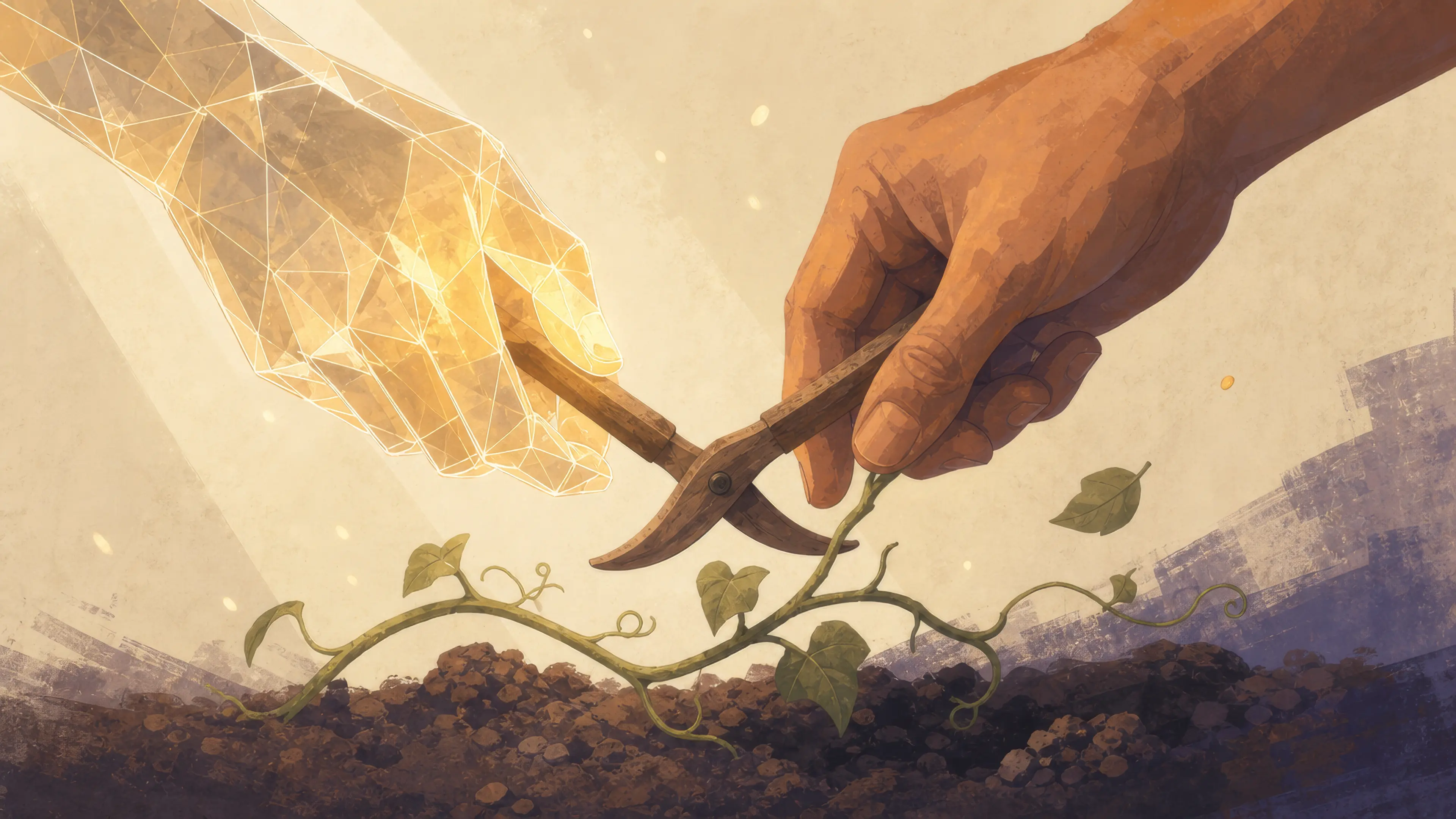
AI tends. You decide. AI should do the retrieval work so you can do the thinking work. It should surface connections you might have missed, resurface ideas you’ve forgotten, suggest affinities you didn’t see coming. But the gardener always decides what takes root. AI proposes, gardener disposes. This is not a compromise, it is the entire philosophy 6 Maggie Appleton’s A Treatise on AI Chatbots Undermining the Enlightenment explores how AI design choices that prioritize sycophancy over intellectual challenge risk eroding critical thinking. This is the dynamic the “gardener disposes” principle pushes against.. The one-click confirmation of a suggested link is the thinking. The moment of recognition — yes, this belongs here — is where understanding happens. Take that away, auto-link everything, and you’ve built a machine that thinks for you while you watch.
Surprise is a feature. Most software optimizes for the obvious. The next thing in the feed. The related post. The algorithmically adjacent. But serendipity, the faculty of finding valuable things not sought for, sits in a sweeter spot: too close is obvious, too far is noise, just right is interestingly distant but meaningful in hindsight 7 Urbano Reviglio in his work Serendipity as a Design Principle of Personalization Systems explores how serendipity can be intentionally cultivated in digital environments, and how the “just right” level of surprise is key to fostering meaningful connections without overwhelming users with noise.. A note about garden design from three years ago should occasionally surface next to a note about software architecture from last week, not because they share a topic, but because they share a purpose. These are the connections that feel like thinking, the ones you didn’t plan, but recognize instantly 8 Making my Own Luck is a great paper that identifies specific strategies people use to cultivate serendipity in their information environments, such as “bumping into things”, “following hunches”, and “embracing the unexpected”.
Tools should grow with you. Not in a settings panel. Not in a configuration file saved somewhere you’ll forget. Customization must happen in the flow of work, in the moment you need it, shaped by the thing you’re actually trying to do 9 The A Design Probe of Malleable AI Interfaces paper identifies the core mismatch: “the rarity of end-user tailoring reflects a mismatch between where customization needs arise (in the flow of real work) and where customization mechanisms live (in separate configuration environments).” Malleable systems “enable a direct loop from breakdown to repair”, embedding customization in everyday workflows. Everything in the garden is a reusable building block that can be composed together, items, filters, views, prompts. A view is simply: what’s in scope, times what skill runs, times where the result goes. You shape it when you need it. It fades back into the garden when you don’t. You bend the tool to fit your thinking, not the other way around.
 Generated with AI
What This Actually Feels Like.
You’re writing a note about something you just read. Quietly, the garden surfaces a bookmark from eight months ago, something you saved and never opened. It shows you why: This connects through the concept of composability — the bookmark discusses modular architecture, and your note is about reusable design components. You read the connection. You decide. One click, and the two are linked. You just thought something new. The thinking happened in the recognition, not in the retrieval.
You’re wandering through your saved items without a specific goal, just walking. The garden is arranged not by date but by associative topography. Clusters form naturally around shared concepts, shared purposes, shared questions. A path you walked three months ago looks different now because new things have grown since then. Every walk through the garden creates new paths, new meanings.
You dictate a messy, half-formed thought on a walk. You don’t organize it. You don’t tag it. You just speak. Later, the garden finds where it belongs. Not by filing it into a folder, but by connecting it to things already growing nearby. The messiness is not the problem. The messiness is the soil.
 Generated with AI
An Invitation.
I’m building this garden because I want to think better, and I suspect you do too. The current tools make it too easy to collect and too hard to connect. They optimize for consumption, more bookmarks, more notes, more saved articles, rather than cultivation. They treat ideas like inventory to be managed rather than plants to be tended.
I am calling it “Oasis” because it’s a place to go when you want to think, a place that feels alive, a place that grows. It’s not a product. It’s a garden in progress. Some beds are well-tended. Others are still wild. The shape will change, that’s the nature of the thing.
If this resonates, if you’ve felt the dissatisfaction with feeds, the fatigue of folders, the quiet suspicion that your best ideas are buried somewhere in a system you built but no longer trust, I’d love for you to follow along. Not as a user. As a fellow gardener.
The garden grows slowly. That’s the point. Plant something. 🪴
This essay has been written in the garden using Oasis and thus with the help of an LLM. It started as a few notes, a couple of bookmarks, a half-formed thought. It grew into something I didn’t expect, and it wouldn’t have been the same if I had planned it out from the beginning. The process of writing it was the process of discovering what I wanted to say.